

A homeowner is ready to sign a $52,000 renovation contract. The GC has strong reviews, a polished proposal, and an available start date. The conversation turns to paperwork. The contractor offers to “email the insurance and license over.” A certificate of insurance arrives. It lists a policy number and an expiration date six months away. The license number is provided in the same email. The homeowner files both documents and moves forward.
This sequence is common. It is also incomplete. A certificate of insurance is not a guarantee of coverage. A license number is not proof that the license is active, correctly classified, or free of disciplinary history. The homeowner who treats these documents as formalities often discovers the gaps only after an injury, a property claim, or a dispute with an unpaid subcontractor.
Licensing: Status, Classification, and History
Most states require residential general contractors to hold an active license for projects above a stated dollar threshold. The exact requirements vary. Some states license the individual, others the business entity. Some require a specific residential or remodeling classification; a commercial-only license may not cover the work.
Verification must be done directly with the issuing state agency or licensing board. Do not rely solely on a number supplied by the contractor. Enter the number into the official lookup tool and confirm four points:
The license is currently active
The classification covers residential remodeling or the specific trade involved
The business name and any qualifying individual match the party named in the contract
There are no open disciplinary actions, suspensions, or recent complaints that raise concern
A license that expired last month or that is held under a different company name is not sufficient. Some contractors operate under multiple entities; the insured and licensed entity must be the one signing the contract and receiving payment.
If the project involves specialized trades—electrical, plumbing, HVAC, or structural work—confirm that the subcontractors who will perform those portions also hold the required trade licenses. The GC’s license does not automatically cover unlicensed electrical or plumbing work in most jurisdictions.
Insurance: The Certificate Is Only the Starting Point
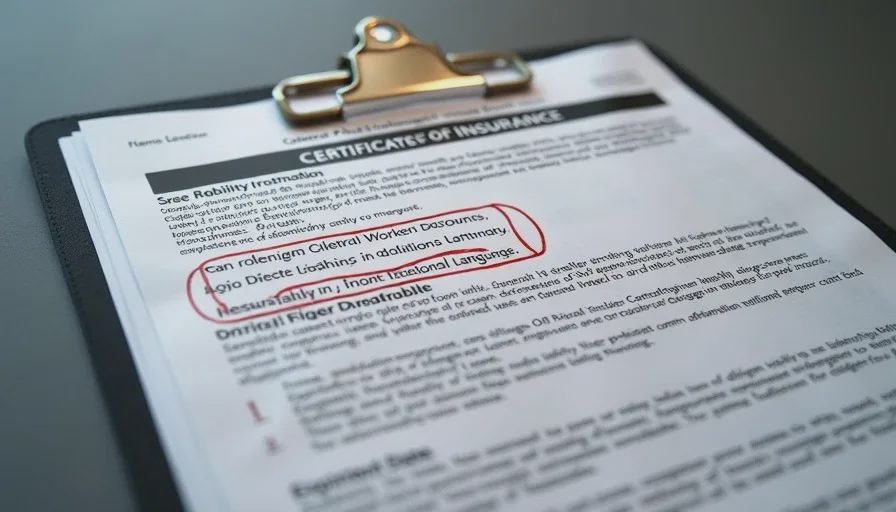
A certificate of insurance (COI) is a snapshot prepared by the insurance broker or carrier. It summarizes coverage at a moment in time. It is not the policy itself and it does not create coverage that does not exist.
The critical fields to examine are:
Policy effective and expiration dates — coverage must be active through the expected project duration plus a reasonable buffer
General liability limits — $1 million per occurrence / $2 million aggregate is a common minimum for residential work; lower limits leave a larger gap
Workers’ compensation — required in most states if the contractor has employees; absence of this coverage can shift injury claims toward the homeowner’s own insurance
Additional insured status — the homeowner (and sometimes the lender) should be listed as an additional insured on the general liability policy for the duration of the work
Cancellation notice — many certificates state that the carrier will “endeavor to” mail notice of cancellation; stronger language or a direct endorsement is preferable
Request that the certificate name the specific project address or state that it covers the work being performed for the named homeowner. A generic certificate that does not reference the job leaves room for later argument about whether the policy applied.
Workers’ compensation deserves separate attention. If the contractor claims to have no employees and therefore no workers’ compensation policy, confirm the status of any laborers who will appear on site. A worker classified as an independent contractor by the GC may still be able to bring a claim that reaches the homeowner if the classification is later disputed.
Additional Insured and Primary Coverage
Being named as an additional insured gives the homeowner direct rights under the contractor’s liability policy for claims arising from the contractor’s work. Without that status, the homeowner may have to pursue the contractor first and hope the contractor’s policy responds.
Ask for an endorsement or policy language confirming that the contractor’s coverage is primary and non-contributory with respect to the homeowner’s own insurance. This reduces the chance that the homeowner’s insurer is drawn into a claim that should have been covered by the GC’s policy.

Practical Verification Sequence
Obtain the exact legal name of the contracting entity and the license number.
Verify the license status, classification, and any disciplinary history on the official state website.
Request a current certificate of insurance that shows general liability limits, workers’ compensation, expiration dates, and additional insured status for the homeowner.
Confirm the certificate directly with the insurance agent or carrier listed on the document if the project is large or the numbers appear irregular.
Require that insurance and licensing remain active as a condition of the contract, with the right to withhold payment or stop work if coverage lapses.
Some homeowners also request a simple statement of the contractor’s bonding capacity or a copy of any performance bond if the project is especially large. Bonds are less common in residential remodeling than in commercial work, but they provide an additional layer when available.
Common Gaps That Create Exposure
The most frequent problems are expired policies, licenses held under a different entity name, missing workers’ compensation when laborers are present, and certificates that do not name the homeowner as additional insured. Any one of these gaps can leave the homeowner facing an uninsured injury claim, a property damage dispute, or an unlicensed-work complication with the local building department.
A contractor who resists providing current, verifiable documentation or who becomes defensive when asked for additional insured status is supplying useful information. The resistance itself is data. Strong contractors treat these requests as routine. The ones who do not may have reasons that only become visible after a problem occurs.
Licensing and insurance are not bureaucratic formalities. They are the baseline mechanisms that determine whether a claim will be covered by the contractor’s policy or will migrate toward the homeowner’s assets and insurance. Verify both directly, document the confirmation, and make ongoing coverage a contractual requirement. The cost of the verification is measured in minutes. The cost of skipping it is measured in five and six figures when something goes wrong.