

A homeowner signs a $48,000 bathroom and hallway renovation. The contract calls for 50 percent at signing and 50 percent at completion. The first check goes out. Demolition starts. Three weeks later the crew slows. The GC cites material delays and a subcontractor conflict. Punch-list items accumulate. The homeowner has already paid half the total and has limited remaining funds to withhold. The final payment is the only leverage left, and it is not large enough to cover the outstanding work plus potential disputes.
This pattern repeats. A 50/50 split looks simple and fair on paper. In practice it front-loads cash to the contractor and strips the homeowner of meaningful control once the project is underway. Residential renovation contracts that protect the owner use progress payments tied to verified milestones and a defined retainage held until the work is actually finished.
How Payment Timing Creates or Removes Leverage
Money is the primary enforcement tool most homeowners possess. Once a large percentage of the contract value has been paid, the incentive for the contractor to resolve problems quickly declines. A 50 percent deposit covers materials, early labor, and a substantial portion of the GC’s overhead and profit before any substantial work is complete. If the project then stalls, the homeowner’s remaining 50 percent may not be enough to hire a replacement crew or to fund the completion of incomplete items.
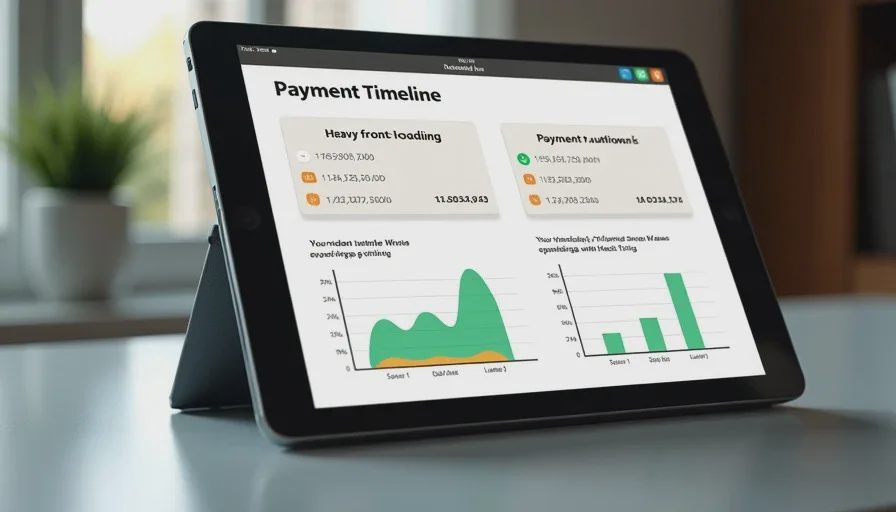
Better schedules keep a larger share of the total value available until later stages. A common protective structure for a mid-sized residential project looks like this:
10–20 percent upon signing and permit submission
25–35 percent at completion of demolition and rough mechanicals (after inspection if required)
20–30 percent at installation of major finishes (cabinets, tile, fixtures)
Final 15–25 percent, including retainage, after final inspection, punch-list completion, and delivery of lien waivers
The exact percentages vary with project length and material intensity. The principle does not: the contractor should not be made whole until the homeowner has a completed, inspected, and accepted result.
Retainage as Standard Protection
Retainage is the portion of each progress payment deliberately withheld until the end of the job. In residential work it commonly runs 5 to 10 percent of each payment, or a flat 5–10 percent of the total contract held from the final draws. The retained amount is released only after substantial completion, final punch-list items are corrected, and the contractor delivers unconditional final lien waivers from itself and its major subcontractors and suppliers.
This practice is routine in commercial construction and widely used by careful residential contractors. It creates a financial incentive to finish cleanly. Without retainage, the last payment is often treated as ordinary profit rather than a performance bond of sorts. With retainage, the contractor has a concrete reason to return for the small items that otherwise linger for months.
Some states cap retainage percentages on public or certain private projects. Residential contracts between private parties still routinely include 5–10 percent terms. A contract that contains no retainage language and relies solely on a large final payment is weaker than one that systematically holds back a defined percentage throughout the work.
Why 50/50 Feels Attractive and Why It Fails
Contractors sometimes propose 50/50 because it simplifies cash flow and reduces administrative work. Homeowners sometimes accept it because it appears balanced and because the GC has strong reviews or a polished presentation. The arrangement works only when the project runs perfectly on schedule and scope. Most renovations do not.
Mid-project discoveries, supply delays, labor shortages, and change-order disputes are normal. When they occur under a 50/50 schedule, the homeowner has already transferred half the economic value of the job. The remaining half must cover both the unfinished work and any corrective costs. If the unfinished work exceeds that remaining half, the homeowner is effectively funding the shortfall out of pocket while still arguing over the original contract.
A milestone schedule changes the dynamic. Each payment is earned only after a defined portion of the work is complete and, where applicable, inspected. The contractor stays motivated to reach the next milestone. The homeowner retains the ability to pause payments if progress stops or quality declines.

Contract Language That Matters
The payment clause should state the exact percentages, the triggering events for each payment, and the documentation required. Vague phrases such as “progress payments as work proceeds” leave room for dispute. Specific language is better:
“Owner shall pay Contractor 15 percent of the Contract Sum upon execution of this Agreement and submission of permit applications. An additional 30 percent shall be due upon completion of demolition and passage of rough plumbing and electrical inspection. An additional 25 percent shall be due upon installation of cabinets, countertops, and primary fixtures. The remaining 30 percent, including 10 percent retainage, shall be due within ten days after final inspection, completion of the punch list, and delivery of unconditional final lien waivers from Contractor and all subcontractors and material suppliers.”
Lien-waiver requirements should be explicit. Conditional waivers accompany progress payments; unconditional final waivers accompany the last payment. Without them, a subcontractor who was not paid by the GC can still file a claim against the property.
Change-order rules should also be tied to payment. Extra work should not proceed without written approval and a stated price or unit rate. Payment for change orders should follow the same milestone logic rather than being due immediately.
Practical Steps Before Signing
Ask for the proposed payment schedule in writing and map it against the project timeline. Calculate how much cash will have been transferred by the halfway point of the calendar schedule. If that figure exceeds 40–45 percent of the total on a multi-month job, push for adjustment.
Request a retainage provision of at least 5 percent. Confirm that the final payment is large enough to cover a realistic punch list plus any remaining material or subcontractor costs.
Obtain at least one competing quote that uses a milestone structure. The existence of an alternative often makes the original GC more willing to revise the payment terms.
A 50/50 split is simple. It is rarely protective. Residential renovation contracts that keep payment aligned with verified progress and that hold a defined retainage until the work is complete leave the homeowner with leverage when problems appear. The schedule is not a courtesy detail. It is one of the primary risk-allocation tools in the agreement. Treat it with the same scrutiny given to the scope of work and the total price.