

A renovation is scheduled for ten weeks. At week twelve the crew is still working on finishes. The original completion date has passed. The contractor cites material delays, a subcontractor conflict, and weather. The homeowner is living in a disrupted house, paying temporary housing or meal costs, and watching the end date move without a clear recovery plan. The contract contains a start date and a general statement that the work will be completed “in a timely manner.” It does not define what happens when the timeline slips.
Schedule slippage is one of the most common sources of friction in residential projects. It is also one of the least precisely addressed in typical homeowner contracts. A clear approach to delays begins with the contract language, continues with contemporaneous documentation, and ends with a realistic assessment of the remedies that remain available once the work is underway.
Common Causes and How They Differ
Delays fall into several categories that carry different implications for responsibility and cost.
Owner-caused delays include late material selections, late payments, restricted access, or changes requested after work has begun. These generally extend the contractor’s time entitlement and may support additional general conditions costs if the contract allows them.
Contractor-caused delays include poor sequencing, under-manned crews, failure to order materials on time, or inadequate coordination of subcontractors. These are the contractor’s responsibility. The homeowner’s remedies depend on what the contract says about time and damages.
Excusable delays include weather severe enough to stop work, labor strikes, or supply-chain disruptions that could not reasonably have been anticipated. Many contracts grant time extensions for these events but do not automatically grant extra money.
The practical problem is that contracts often fail to distinguish among these categories or to require prompt written notice when a delay event occurs. Without notice and documentation, every slippage tends to be presented as unavoidable and every request for acceleration or recovery becomes a new negotiation.
Contract Language That Creates Accountability
A useful schedule clause does four things.
It establishes a substantial completion date or a duration measured in calendar days from a defined start event (permit issuance, deposit clearance, or mobilization). “As soon as possible” or “in a professional manner” is not a schedule.
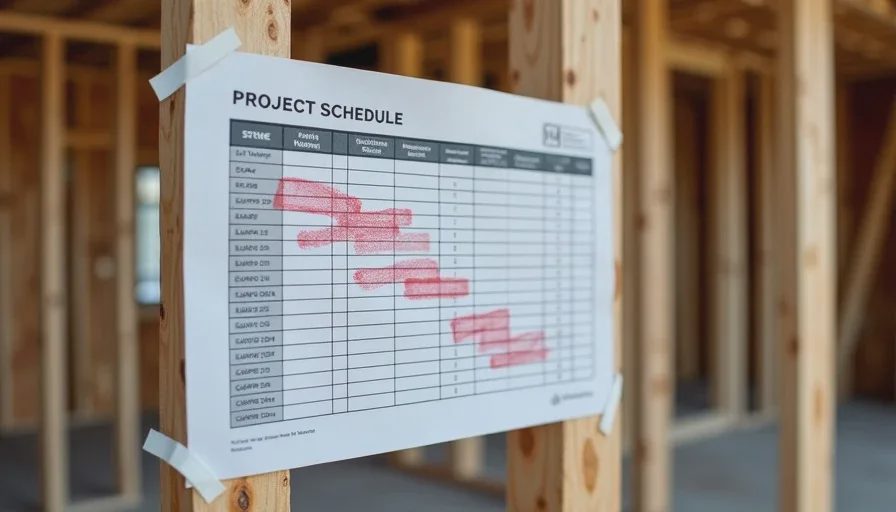
It requires the contractor to provide a simple baseline schedule showing major milestones—demolition, rough-in, inspections, finishes, final walkthrough—and to update that schedule when milestones slip by more than a stated number of days.
It defines the process for claiming a time extension: written notice within a short period after the delay event is known, with a description of the cause and the expected impact. Failure to give timely notice can waive the claim for extra time.
It addresses the consequences of non-excusable delay. Options include liquidated damages (a stated daily amount), the right to withhold payment for extended general conditions, or the right to terminate for default after notice and a cure period. Liquidated damages must be a reasonable pre-estimate of actual harm to be enforceable in most jurisdictions; an arbitrary high number risks being struck down. Even a modest daily figure creates a financial incentive to recover time.
Many residential contracts omit these elements entirely. The resulting silence leaves the homeowner with limited practical leverage once the crew slows down.
Documentation While the Delay Is Occurring
The contemporaneous record determines how later conversations unfold. When a milestone is missed, note the date, the stated reason, and any recovery plan offered by the contractor. Photograph the site condition on that date. Save emails or texts in which the contractor acknowledges the slip or attributes it to a specific cause.
If the contractor requests a time extension, require the request in writing and respond in writing—either granting a defined extension, granting it with conditions, or reserving rights. Silence can later be characterized as acquiescence.
Track any extra costs the household incurs because of the delay: temporary housing, extended storage, additional meals, or time off work. These figures become relevant if the contract allows recovery of actual damages or if the dispute moves to mediation or arbitration.

Practical Remedies Once Slippage Is Clear
The available responses depend on the contract and on the severity of the delay.
Withholding a progress payment that is tied to a missed milestone is often the most immediate tool, provided the payment schedule is written that way. Releasing funds for incomplete or delayed work reduces leverage.
A formal written notice of delay and demand for a recovery schedule puts the issue on record and forces the contractor to respond. Many disputes de-escalate once a concrete recovery plan is required in writing.
If the contract contains a termination-for-default clause and the delay is severe and uncured, termination remains an option. It is a high-cost step—finding a replacement contractor mid-project is expensive and disruptive—but the existence of a clear contractual path makes the threat more credible.
Liquidated damages, when present and enforceable, can be assessed according to the contract terms. Even when the contract is silent, a well-documented record of owner-caused extra costs can support a later claim for actual damages in negotiation or formal dispute resolution.
Preventive Steps Before Work Begins
Ask for a baseline schedule with major milestones as part of the contract documents. Require written notice of delays within a defined period. Consider a modest liquidated-damages figure tied to a realistic estimate of household disruption costs. Make clear that time extensions for excusable delays still require timely written notice and do not automatically include extra compensation.
Confirm material lead times for long-lead items—custom cabinets, windows, specialty fixtures—before the start date is fixed. Many “delays” are simply the result of ordering too late.
A renovation schedule will almost never run exactly as first drawn. The difference between a manageable slip and an open-ended disruption is determined by whether the contract defines the rules, whether the homeowner documents the events as they occur, and whether payment and notice provisions preserve enough leverage to demand a recovery plan. Build those elements into the agreement. Once the crew is on site and the original end date has passed, the opportunity to set the rules has already closed.